
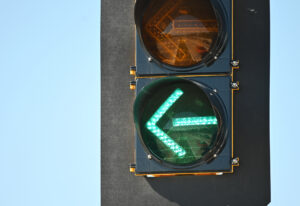
Left-turn and T-bone collisions are among the most dangerous crashes at San Fernando intersections. When one vehicle hits the side of another, the people inside have only a door and a window to protect them. These crashes often happen on busy roads like Truman Street, San Fernando Road, Maclay Avenue, and Brand Boulevard, where heavy traffic and frequent turns create constant conflict. In most of these cases, fault comes down to one question: who had the right of way? Pilavjian Law investigates intersection crashes to show which driver failed to yield and to hold them accountable.
Who Is Usually at Fault in a Left-Turn Accident?
Under the California Vehicle Code, a driver turning left must yield to oncoming traffic that is close enough to be a hazard. Because of this rule, the left-turning driver is often found at fault when they turn in front of an oncoming car.
That doesn’t mean the turning driver is automatically responsible. The oncoming driver may share fault or be fully responsible if they:
- Ran a red light or entered the intersection on a late yellow
- Were speeding, which made it impossible for the turning driver to judge the gap
- Were distracted by a phone or other device
- Were driving under the influence
- Passed illegally or drove in a turn-only lane
How Is Fault Determined in a T-Bone Crash?
T-bone collisions usually happen when one driver enters an intersection when they shouldn’t have. Several right-of-way rules may apply.
Signalized Intersections
At traffic lights, the driver who ran a red light is usually at fault. These cases often turn on conflicting accounts of who had the green light, which is why independent evidence is so important.
Stop Signs and Uncontrolled Intersections
At a four-way stop, the first vehicle to stop has the right of way. If two vehicles arrive at the same time, the driver on the left must yield to the driver on the right. At intersections with no signs or signals, the same basic rules apply. A driver who rolls through a stop sign or ignores these rules can be held liable for the crash.
Private Driveways and Parking Lots
Drivers pulling out of driveways, alleys, or shopping center lots must yield to traffic already on the road. Many San Fernando side-impact crashes happen when drivers misjudge the speed of oncoming cars while leaving businesses along busy streets.
What Evidence Proves Who Had the Right of Way?
Because drivers often disagree about what happened, strong evidence is essential. Useful evidence in intersection crashes includes:
- Traffic camera and nearby business surveillance footage
- Dashcam video from involved or passing vehicles
- Independent witness statements
- Signal timing data from the city
- Event data recorder information showing speed and braking
- Vehicle damage patterns and accident reconstruction analysis
Surveillance footage is often deleted within days or weeks, so acting quickly matters. Learn more about how we investigate car accident claims.
What If Both Drivers Share Fault?
California follows a pure comparative negligence system. Even if you were partly responsible, you can still recover damages, reduced by your share of fault. For example, if you were found 20 percent at fault, your compensation would be reduced by 20 percent. Insurance companies often try to push more blame onto injured drivers to lower payouts, so careful investigation protects the value of your claim.
What Injuries Are Common in Side-Impact Collisions?
Side-impact crashes often cause traumatic brain injuries, broken ribs and pelvises, spinal injuries, and internal organ damage. Some victims face long recoveries or permanent disability. When injuries are this severe, the claim may be handled as a catastrophic injury case that accounts for long-term medical care and lost earning capacity.
Talk to a San Fernando Car Accident Lawyer
If you were hurt in a left-turn or T-bone crash, the other driver’s insurer may already be building a case to blame you. Pilavjian Law works quickly to preserve evidence, prove who had the right of way, and fight for full compensation. We charge no fee unless we win. Call (818) 380-3021 today to schedule your free consultation.